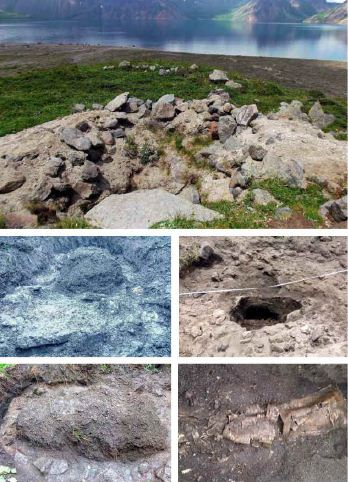
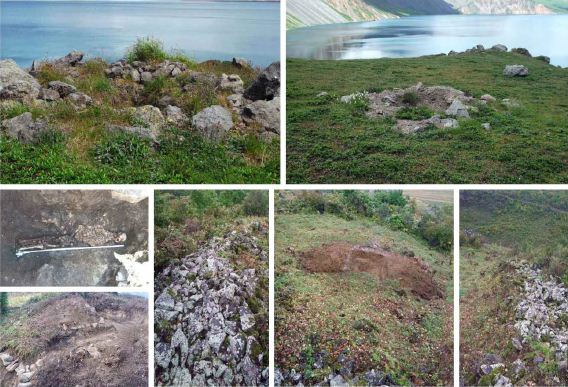
True to the Workers' Party of Korea's intention of unearthing more excellent cultural heritage elements of our country, the research group of the History Faculty of
The historical remains unearthed in Mt Paektu and the vast areas around it are the graves dating back to the period of the feudal Joson dynasty (1392-1910), and thus they constitute convincing objective historical materials proving that the Korean ancestors buried their ancestors' remains there.
On the basis of a comprehensive study and analysis of the distribution of the graves, the characteristics of Korean and foreign graves and Korean and foreign funeral modes, the research group confirmed that the newly unearthed graves originated from those use by the Palhae people living in Ryanggang and South and North Hamgyong provinces and Northeast China in terms of grave form and funeral mode and are fundamentally different from those of other nations in grave form and funeral mode as the remains of all the graves were wrapped with the bark of white birch before being laid in pits and their earth mounds were covered with stones as a whole or on about half of their lower part.
The radiocarbon dating of the remains done jointly with the Russian National University in Novosibirsk proved that most of the remains in the graves were of the Koreans who lived in the mid-18th century to the mid-19th century. This clarified for the first time the historical fact that the Koreans who lived in the Mt Paektu area, including Ryanggang and North Hamgyong provinces, had brought their ancestors' remains to the shores of Lake Chon and buried them there.
The Archaeology Society of the DPRK evaluated after examination that the remains in the graves unearthed in the areas of Ryanggang and North Hamgyong provinces, including Lake Chon on Mt Paektu, were of the Koreans who inherited the customs of Palhae.
Previously unearthed in the shore of Lake Chon on Mt Paektu were the ruins of the altar used to make sacrifices to the sky and the earth during the period of the feudal Joson dynasty and the remains related to the Taejong Faith buried pray for the emergence of a sage to save Korea during the Japanese imperialist colonial rule over it. This time there have been unearthed the graves. This scientifically proves the clear historical fact that the Koreans hewed their way through long miles of primeval forests to reach Lake Chon and bury their ancestors' remains on its shores generation after generation, deeming it their ancestral mountain and sacred territory.