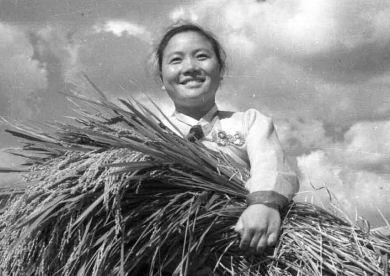
The Korean women have brought about a great change in the revolution and construction as a powerful force for the development of the state and society which turns one of the wheels of revolution.
The proud history of mass movement has recorded the plowwoman movement vigorously waged by the Korean women in the flames of the grim Fatherland Liberation War.
The respected Comrade
"In the days of the anti-Japanese revolutionary struggle our women waged a bloody struggle with weapons in hand to liberate their country. In the days of the fierce Fatherland Liberation War they fought do-or-die battles on the frontline and in the rear to defend their country against the imperialist aggression, displaying unparalleled bravery and a self-sacrificing spirit."
During the Fatherland Liberation War, women in the countryside turned out as one in the movement of plowing the field, saying "Let us give deaths to the enemies in revenge with increased grain production in the place of husbands, sons and brothers who have gone to the frontline!". In this movement, the women of serviceman's families and the bereaved families of patriotic martyrs played the leading role.
They tilled the fields day and night taking ploughs firmly in hand and driving the camouflaged ox despite the enemy's barbarous bombing raids.
Kim Rak Hui, the pioneer of the plowwoman movement, took the lead in plowing the field, bearing in mind the militant appeal of President
Plowing the field was a work beyond a frail girl's physical power. Utterly exhausted at first, she sank down on the ground many times. Then, each time, thinking that the land given by the great leader and permeated with the blood of the forerunners must not be left idle even an inch until death, she gathered herself up, clenching the plough firmly, and, at last, finished the field as wide as 500 phyongs by her own efforts. Following her example, in less than a few days, more than 40 women turned out in working the soil taking the ploughs, and soon a spring-ploughing shock brigade was formed with women.
Later, Kim Rak Hui led over 80 women in the village to train them into plowwomen and introduced cold-bed seedlings into paddy fields to produce 13 tons of rice per hectare, making a great contribution to ensuring the wartime food supply.
Kim Rak Hui's example was quickly disseminated across the country and thousands of women turned out in taking the ploughs in their hands.
Women's campaign for ploughing fields was driven as a mass movement and, as a result, in Hwanghae Province alone, more than 5 000 plowwomen were produced in 1952. The women in Hungam-ri, Songhwa County formed a plowwomen's shock brigade in place of their husbands who went to the front and raised crops while fighting the enemies not only in their village but also went to the neighboring village to bring all the fallow land under plow to produce more even a grain.
In late March 1952, 73 Hungam-ri women with knapsacks and farm implements, together with the self-defence corps members, took seven cattle to a neighboring village and successfully finished ploughing and sowing over 30 hectares. They carried to the front the rice grains produced at the cost of their blood and sweat while fighting fierce battles against the enemies crawling from Cho Island.
Like this, the women's movement made a great contribution to solving the rural manpower problem, ensuring the increased food production of wartime without even an inch of land lying idle. It was also of great significance in breaking old traditional customs of thinking that plowing the fields is entirely man's job, training women ideologically.
Indeed, the women's campaign to plow the fields in wartime was a revolutionary mass movement through which the Korean women, who were unbearably maltreated and oppressed in the past regarding it as their inevitable fate, became new beings as the defenders of their country and independent people with the indomitable spirit that even an inch of the country liberated by the great leader could not be overlooked.