Recently, researchers of the Center for Advanced Technology Research and Development at
PtMo-2/C electrocatalyst was synthesized by the formic acid reduction method following heat-treatment with H2PtCl6•6H2O and (NH4)6Mo7O24•4H2O as precursor salts.
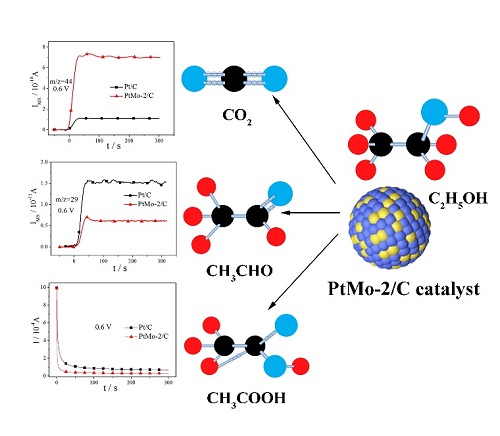
The potentiodynamic study showed that the PtMo-2/C catalyst has the higher CO2 current efficiency (8.8 %) than the Pt/C (6.9 %) during the EOR. The potentiostatic results of the EOR revealed higher kinetics in the potential range from 0.6 V to 0.8 V (vs. RHE) on the Pt/C compared with PtMo-2/C because of the faster dehydrogenation of ethanol on the Pt/C with higher content of Pt. DEMS results exhibited that the CCE (9.8 %) for PtMo-2/C is higher than that (7.7 %) for Pt/C after calibration of the m/z = 44 mass signal, which suggested the addition of Mo not only enhances the oxidation of CO to CO2 by offering more OH species due to the bifunctional mechanism, but also reduces the coverage of COads on the Pt surface due to the decreasing of Pt-CO binding energy, producing more catalytically active sites and more CO2 for ethanol electrooxidation.
The results were published in the journal "Physical Chemistry Chemical Physics" (2025, Vol. 27, pp 16030–16038) under the title of "Ethanol electro-oxidation on carbon-supported Pt-Mo electrocatalyst: A study by pinhole on-line differential electrochemical mass spectrometry"(https://doi.org/10.1039/d5cp01253h).