In recent years, the problem of environmental pollution and traffic noise caused by traffic vehicles in urban has become serious, and it is important to solve the problem of increasing the efficiency of public transport.
On the basis of evaluating the queue length of traffic vehicles at the urban intersection, we studied an algorithm to reduce waiting time and increase its utilization by prioritizing public traffic.
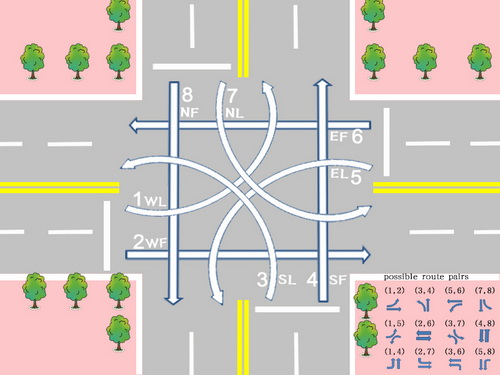
As shown in the figure, there are 12 possible pairs of lines at the common intersection, and we propose a step-by-step prediction algorithm to predict the queue lengths of the next stage at the time of passing a corresponding pair of lines based on the formularization of queue lengths based on the input/output flow of traffic vehicles.
The proposed algorithm prioritizes the passage of public transport vehicles by applying appropriate weighting factors to them based on the prediction of the next queue length at the time of signalling a queue at the intersection and reduces the waiting time.
The superiority of the proposed algorithm is verified using SUMO, a traffic simulation tool.
According to the simulation results, it is confirmed that the proposed algorithm can reduce the waiting time of public transport vehicles by up to 30% even if the influence on the waiting time of other vehicles is taken into account.
The results of this study were published in the journal Public Transport under the title of "Traffic signal priority control for public transport rapid transit base on a step-by-step prediction algorithm" (https://doi.org/10.1007/s12469-024-00364-w9).